Nonstandard Errors
Journal of Finance, 2024 Part of Firms and financial market structure
Abstract
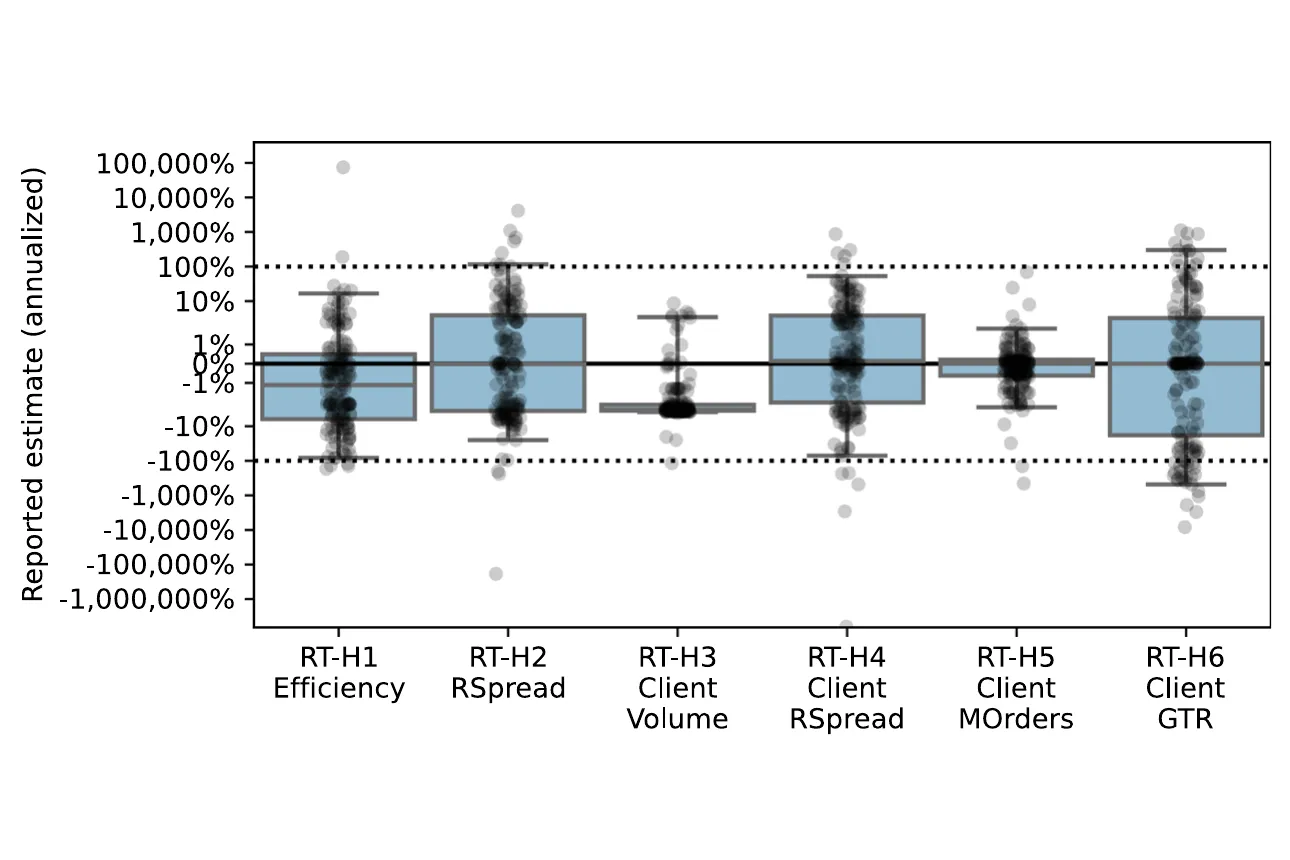
In statistics, samples are drawn from a population in a data-generating process (DGP). Standard errors measure the uncertainty in sample estimates of population parameters. In science, evidence is generated to test hypotheses in an evidence-generating process (EGP). We claim that EGP variation across researchers adds uncertainty: non-standard errors. To study them, we let 164 teams test six hypotheses on the same sample. We find that non-standard errors are sizeable, on par with standard errors. Their size (i) co-varies only weakly with team merits, reproducibility, or peer rating, (ii) declines significantly after peer-feedback, and (iii) is underestimated by participants.
Cite
Albert J. Menkveld et al. (2024). "Nonstandard Errors." The Journal of Finance 79(3): 2339–2390.